Start Here: The Protocol Map
What protocols are, where they live, how this library teaches them, and your free bench
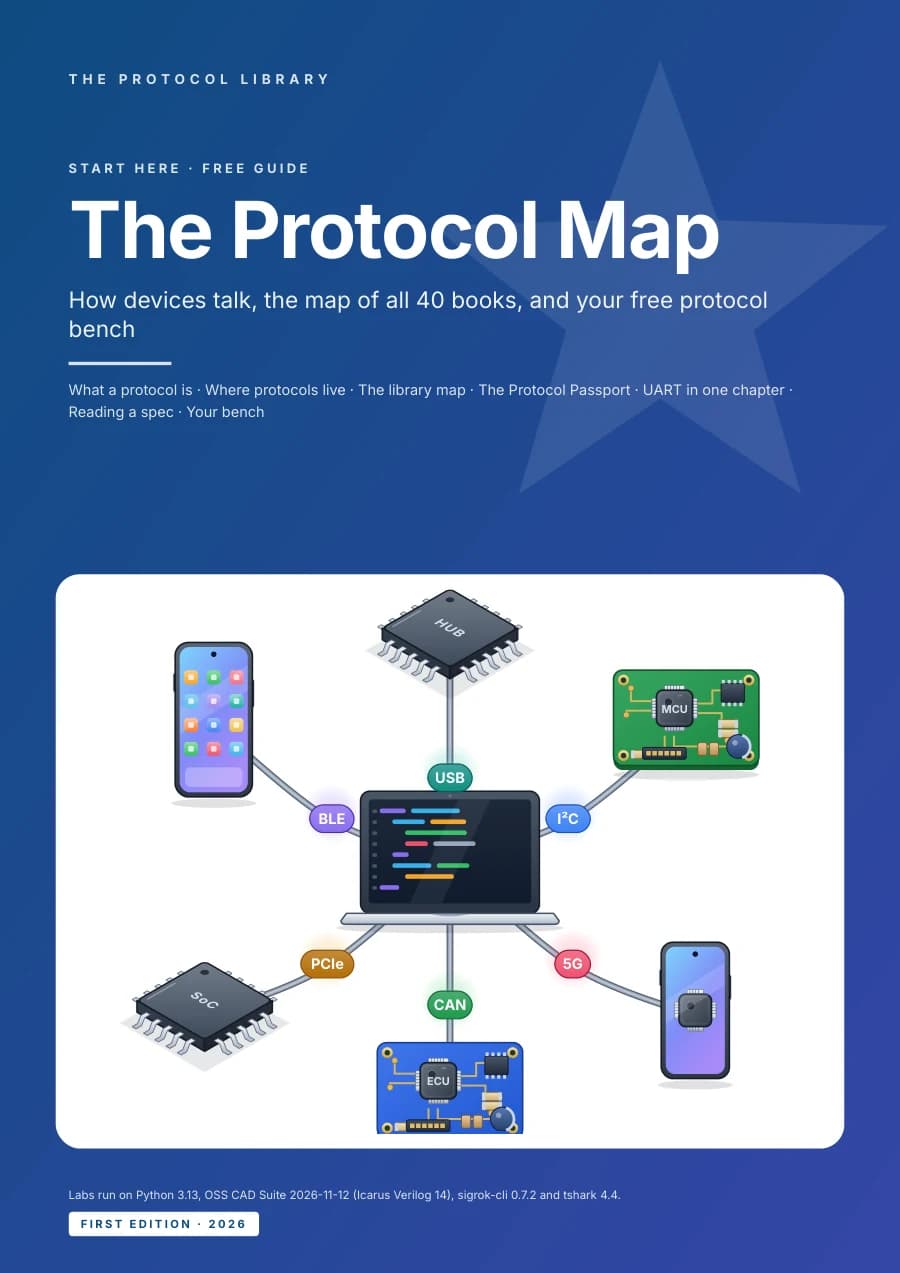
How devices talk, the map of all 40 books, and your free protocol bench
- 166
- pages
- 6
- chapters
- 81
- figures
- 8
- labs
What this book covers
The scope of Free guide
From the series plan. Underlined names are Tier A protocols (several chapters), plain names Tier B (a full chapter), italic names Tier C (a compact section); bold labels group the topics.
- what a protocol is, compared with an interface, an electrical standard, a data format and a crypto algorithm
- the illustrated protocol map: what talks to what inside a phone, a car, a factory, a data centre and a satellite
- the Protocol Passport method (§6) and how to read a spec and a datasheet
- the free tool bench and an optional hardware kit
- study paths by career, and a short sample dossier (UART-lite) so a buyer can see the style
About this book
Why this book, and how it is built
This free guide opens The Protocol Library: forty books that teach every electronics and communication protocol an engineer meets, deeply enough to answer any question about it. Before you study any one protocol, it shows you the whole map, the method every book uses, and one complete protocol, UART, taught the way the series teaches all of them.
You will learn
- What a protocol is
- Where protocols live
- The library map
- The Protocol Passport
- UART in one chapter
- Reading a spec
- Your bench
Labs run on Python 3.13, OSS CAD Suite 2026-11-12 (Icarus Verilog 14), sigrok-cli 0.7.2 and tshark 4.4.
Contents
2 parts, 6 chapters
Page counts are from the finished PDF. Open a chapter to see what you will be able to do after it.
Front matter: About This Book · Contents · List of Figures · List of Labs · How to Use This Book · Learning Outcomes
The Big Picture
What a protocol is, where protocols live, and how this library is organised.
1What a Protocol Is (and Is Not)16 pages · 6 learning outcomes · 1 labs
Every device you own talks to other devices. A sensor talks to a controller, a phone talks to a headset, a car's brake unit talks to its engine unit, and a server talks to the whole world. None of this works unless both sides follow the same rules. This chapter explains what those rules are, what they are called, and why engineers so often use the wrong name for them. You will follow one real temperature reading from a greenhouse sensor all the way to the wire and back, and in the lab you will decode it yourself.
- Explain what a protocol is, and name its three kinds of rule: format, meaning and timing.
- Tell a protocol from an interface, an electrical standard, a network standard, a data format and a security algorithm, and correct the common mix-ups.
- Trace one sensor reading through every layer of a real link: data format, Modbus RTU, CRC, UART and RS-485.
- Answer the five questions every protocol answers (who, when, how fast, what format, what if it fails) for a real link.
- Explain why protocols are built in layers, and say which layers change when a link moves to a new medium.
- Say how the Protocol Passport of this library turns the five questions into 16 fields.
2Where Protocols Live16 pages · 6 learning outcomes
Chapter {ref:ch-what-is-a-protocol} followed one reading along one cable. Real products have dozens of links like that one, each with its own protocol. This chapter takes you on five illustrated tours: inside a phone, a car, a factory, a data centre, and an aircraft and a satellite. On every tour, each link is numbered and named, and the text says in a sentence or two what it carries and which book of this library teaches it. You do not need to understand every name yet. The goal is a map: after this chapter, when you meet a protocol, you will know where it lives.
- Name the main links inside a smartphone and the protocol on each, and the phone's radio links.
- Name the buses of a modern car and say what each carries, including the diagnostics port.
- Describe the levels of a factory network, from 4–20 mA sensors up to OPC UA and MQTT.
- Name the protocols inside a server and between the servers of a data centre.
- Name the data links of an airliner, a satellite and a drone.
- Explain how distance, speed, cost, power and safety decide which protocol a link uses, and find the book that teaches it.
3The Library Map14 pages · 5 learning outcomes
The first two chapters showed what a protocol is and where protocols live, from a phone to a satellite. You have now met dozens of protocol names, and there are hundreds more. This chapter is the map of the library that teaches them: thirteen shelves, this free guide and forty books, the rule that gives every protocol one home, and the method that every book uses. It ends with study paths for eight careers and the order in which the books appear, so you can plan your own route.
- Find the shelf and the book that teach a protocol, using the library wall and the home-book rule.
- Explain what the depth tiers A, B, C and D give a protocol, and what each means for you as a reader.
- Say where in the Protocol Dossier to look for a frame format, a timing number, a fix or a summary.
- Describe how each book proves its promise: outcomes, desk labs with real output, question universes, blind tests and a final test.
- Choose a study path for a career and plan the order in which to read the books.
The Method
How every book teaches a protocol, one complete example, how to read a specification, and your own bench.
4UART in One Chapter: A Complete Sample Dossier33 pages · 7 learning outcomes · 3 labs
You now know what a protocol is, where protocols live, and how this library is organised. In this chapter you see the method at work on one real protocol: the **UART**. Almost every electronic board has at least one, so it is the protocol engineers meet first. It is also simple enough to teach completely in one chapter, part by part, in the same order that every book in the series uses. Book 2 returns to the UART in full depth and adds RS-232, RS-422 and RS-485.
- Fill in the Protocol Passport of a UART link and explain each entry.
- Draw a UART frame (8N1, 7E1, 8O2) bit by bit and explain why it starts low and ends high.
- Compute bit time, frame time, throughput efficiency and the largest baud-rate mismatch a receiver can tolerate.
- Explain how a receiver finds the start bit and samples each bit (16× oversampling, mid-bit sampling).
- Recognise parity, framing, overrun and break conditions and say what causes each.
- Wire two UART devices correctly (TX to RX, common ground, matching logic levels) and spot the classic wiring mistakes.
- Read a decoded UART capture and use the debugging playbook to find a fault.
5Reading Specifications and Datasheets16 pages · 5 learning outcomes · 1 labs
Every number in the UART chapter came from a document. The 16-byte FIFO and the line control register came from a UART data sheet, the RS-232 voltages from a summary of the TIA-232-F standard, and the "±2 %" receiver limit from a microcontroller data sheet. Every book in this library rests on such documents, and as an engineer you will read them every week. This chapter shows who writes them, how to get them, how to find the right edition, how to read their strict language, and how to find one number in a datasheet and check it. Book 1, Chapter 17 takes the same skills further.
- Tell a specification from a datasheet, and name the body that writes a given standard.
- Say whether a specification is free, sold or for members first, and find its edition, amendments and errata.
- Read normative language (shall, should, may, can, NOTE) and the structure of a standard.
- Find your way around a datasheet: absolute maximum ratings, operating conditions, electrical and timing characteristics, register maps.
- Find one number in a datasheet, check it against its formula and use it in a design.
6Your Protocol Bench18 pages · 6 learning outcomes · 3 labs
In Chapter {ref:ch-uart-in-one-chapter} a Verilog transmitter sent "Hi!", and sigrok turned the captured wire back into the three letters. Every book in this library works like that: a free tool makes or captures a signal, and another free tool explains it. This chapter sets up that **bench** on your own computer. You install four free tools, check them, and make your first two captures: one of a wire and one of a network packet. Then you meet an optional low-cost hardware kit and its safety rules. Book 1, Chapter 21, teaches the instruments in depth; this chapter gets you set up and successful.
- Name the four free tools of the desk bench, say what each one does, and draw how they connect.
- Install the bench on Debian or Ubuntu, or on Windows through WSL 2, and check that it works.
- Run a simulated UART capture, decode it with sigrok, and read its VCD times and sample numbers by hand.
- Build packets with scapy, dissect them with tshark, and count a packet's bytes layer by layer.
- Choose a low-cost hardware kit and connect it safely: voltage levels, ground first, static, never mains.
- Fix the common setup problems with the troubleshooting table.
Appendix A
Final Test
7 pages
Appendix B
Answers
15 pages
Appendix C
Revision Cards
3 pages
Appendix D
Glossary
9 pages
8 labs
Every lab in the book, run on free tools
Desk labs run on a laptop; their printed output comes from real runs.
Chapter 1
What a Protocol Is (and Is Not)
- 1.1The greenhouse capture
Chapter 4
UART in One Chapter: A Complete Sample Dossier
- 4.1UART on the wire
- 4.2UART timing maths
- 4.3Two programs on a virtual serial cable
Chapter 5
Reading Specifications and Datasheets
- 5.1Recompute the numbers in a data sheet
Chapter 6
Your Protocol Bench
- 6.1Check your bench
- 6.2Your first signal capture
- 6.3Your first packet capture
Look inside
Real pages from the PDF
Tap a page to see it full size. These are the pages exactly as you get them.
0 protocols at home here
Protocols this book teaches
From the series register. This book is each one's home: the place it is taught in full. Other books only use it.
This guide maps the whole series rather than teaching protocols of its own.
Also used here, taught in full elsewhere
Foundations